Pompeii (Italy Post #5)
- Ally Dunn
- Oct 18, 2022
- 7 min read

A city buried in stone and ash, capturing ancient Greek and Roman history...how can I even begin to talk about everything we saw in Pompeii! So many photos too!
We arrived late on October 12th as our 8 hour train ride from Ortigia was delayed another 2 hours in Messina, forcing us to arrive close to 7pm. We were sat next to a bunch of loud Italian guys who yelled at each other over 2 rows of seats and felt the need to come stand in the middle of the alley to chat (aka yell some more).
It was already dark when we arrived, but once we had checked in we walked down the street to check out a small mom-and-pop pizza place. They worked out of the typical small wood-fired stone oven and made excellent pizza.
Our tour of Pompeii was booked for October 13th at 9am. It was a 2 hour tour, but the guide would finish inside the archeological park and we would be able to spend the rest of the day there if we wanted to. As luck would have it, we got rained on all day, but I think it helped keep some of the tourists away too. This was some random Thursday in the shoulder season and yet there were hundreds of people everywhere, with guides speaking many languages as well.

I don't know if I'll be able to describe everything we saw. Afterall, it is a whole city buried, with some of it still being excavated and restored. We spent time with our tour guide who led us to houses, stepping stones, drinking fountains, shops, the temple of Apollo, theaters, and a forum, before wandering further by ourselves. Then, we went back for another few hours the next day, since each place on the map seemed to unviel more and more of the city. Imagine your entire town or city today being buried, frozen in time What would be left behind?

The different types of architecture allowed archeologists to date the construction of walls and of different housing updates, as well as differentiate between rich and poor families. Rich families often had engravings and mosaics spelling out their names too, with detailed frescoes in their homes, on buildings, and even on the streets, pointing out political figures, different store types, or the profession of whomever lived there.

Everything in a rich family's house was designed to shout out how affluent they were. They would take perfectly functional structures, dress them up, and add intricate details. Pillars would be decorated and have layers of stucco to created designs, paintings and frescoes. Ceilings and floors would have fancy, detailed mosaics made of hundreds or even thousands of tiny colourful stones, even sometimes in the basement cellars. Fountains, detailed doors, intricate paintings and large sculptures were also common. Just to demonstrate to any guests just how much money or political standing they had.
All the below photos are from rich houses filled with fountains, foyers, courtyards, and mosaics.





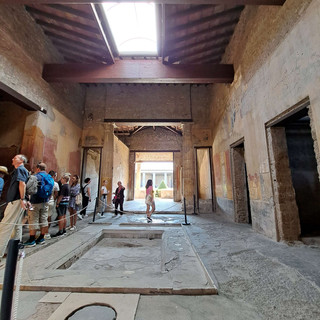





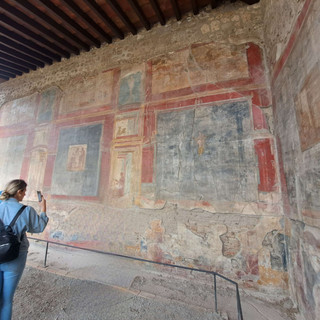

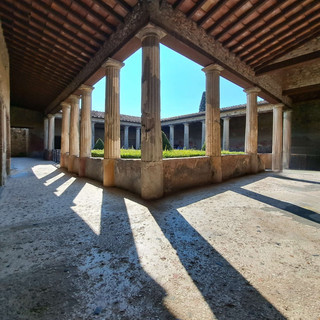


Many houses had a large entry way, often covered in a mosaic, and detailed frescoes with bright colours and designs. They were beautiful and well preserved, allowing one to imagine the high class life people would have lived. Snakes were a common symbol on the frescoes, representing abundance, good fortune and fertility. Many paintings were preserved that involved snakes, along with different Greek and Roman gods.


Typical working citizens also had a lot of items preserved too. Clay pots set into stone or marble counters represented "fast food" shops, a place to buy different hot food items. The clay could keep the food warm and sometimes there was an opening underneath to stoke a small fire.


Grain mills and ovens survived, often found together in the ruins. One was even reconstructed to show everyone how large the mill was, with a mule often being used to mill the grain.

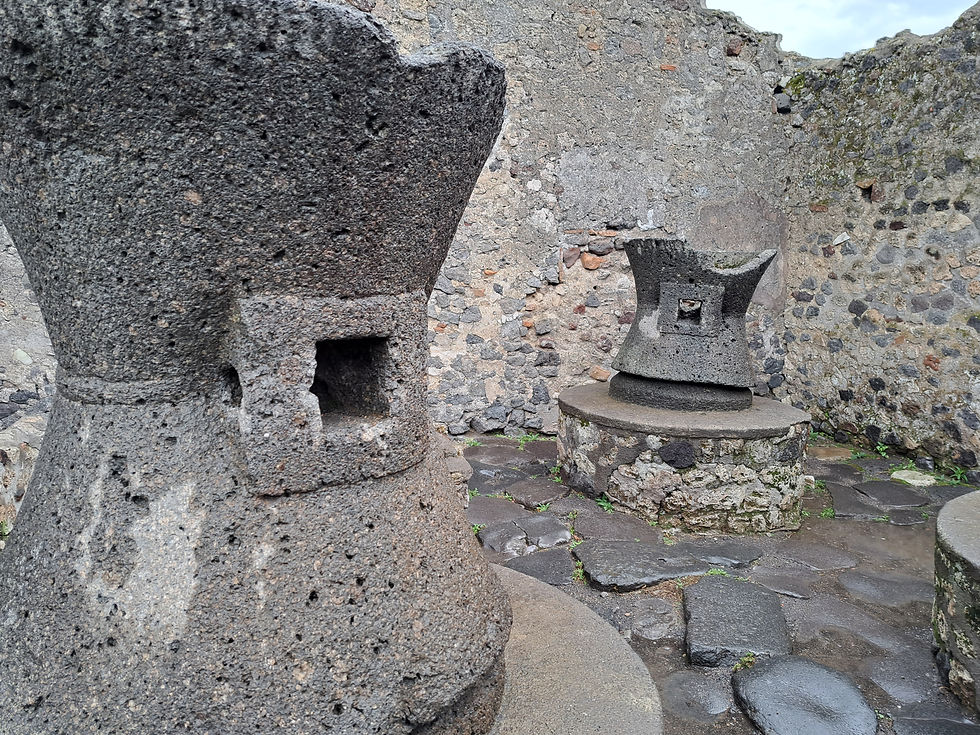
Carson was stoked to find out that many loaves of bread had also been found in the ovens of Pompei. Unfortunately, they had been left to bake too long (2000 years too long!) and were burnt, but still an incredible artefact to discover.

Other food items also survived, including peach stones, dried figs, and walnuts. Another interesting item was the soles from shoes and sandals made of cork, just like our Birkenstocks. Even a small clay ampule and some dice had been found!

In the streets, there were often large stones laying across street crossroads. These were so you could cross the street without stepping down off the curbs. In Pompeii's history, there was an earthquake that destroyed some of the sewage and water lines, meaning they were flowing into the streets. The stones allowed you to not step down into the muck. Some of the streets also had deep ruts and pot holes, since horses and carts were used. Horse skeletons and old carts have also been found, though each were missing pieces and have since been reconstructed.

The amount of excavation and restoration work within Pompeii was also immense. Most houses had collapsed under the weight of the pummice stones, and some houses were 2 or 3 stories tall. Many buildings that had collapsed ceilings had their mosaics and/or frescoes reconstructed, tile by tile, piece by piece.

A lot of the artifacts that are in Pompeii are recreations of priceless originals. One house had a 1.5 million tile mosaic that was picked up and taken to the Napoli Archeological Museum and then reconstructed with less expensive tiles in the house. Extremely delicate work.
Bath houses also held a large amount of tile work in multiple rooms, usually one floor hot, one for tepid/warm and another for cold. Some rich houses even had their own private ones. A very rich, reclusive bath house had the main purpose of housing prostitutes, demonstrated by paintings on the walls showing both men and women inside a change room. It was apparently the only one found throughout Pompeii and was very far from the city center, indicating its reclusivity. Brothels were very common in Pompeii, with many having been uncovered behind taverns or even as stand alone buildings with stone carved beds. Popular prostitutes even had their names engraved into the building walls too.

The amphitheater also housed engravings from both prostitutes and gladiators. Arches in the doorways surrounding theaters and amphitheaters were often the place to meet up with a sex worker and were covered with names. Gladiators names were found elsewhere within the amphitheater.

The large amphitheater of Pompeii would have seated about 20,000 people. In collection with the small and large theaters, the Greeks and Romans had no shortage of entertainment. Gladiators usually wrestled and fought with each other in the amphitheater, but their training grounds and housing had also been uncovered within Pompeii as well.
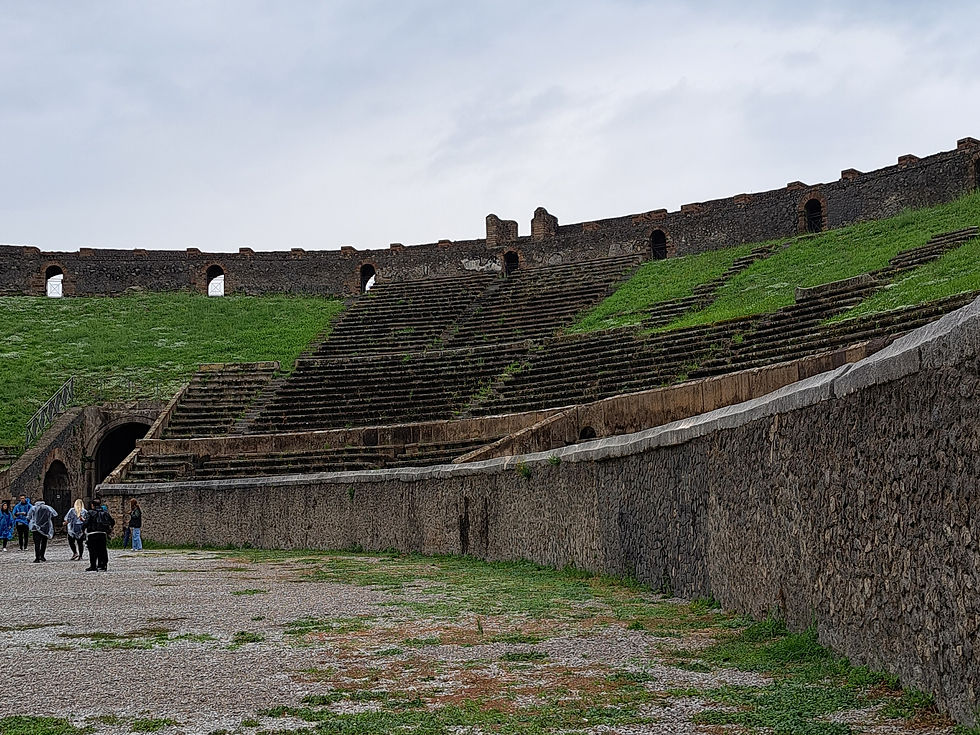

The large and small theaters would have seated 5,000 and 2,000 people, respectively, and sported large intricate pillars around the stage. The steep stone steps in the theaters were worn in a curved shape by the thousands of feet that had stepped on them over time.

The Garden of Fugitives, a large attraction in Pompeii displaying plaster casts of the bodies of several victims of the eruption, was actually such a small part of the archeological park overall. The bodies were made with plaster of Paris and are different than a regular fossil cast. The organic material from the bodies had decomposed, leaving behind the bones and a void in the shape of the dead body trapped under layers of ash. The casts actually have the bones inside of them which is very rare and cool to see. Their faces, however, are suspected to have been sculpted by the original archeologists who molded them to draw more attention and tourism to the park. It worked, obviously.

Pompeii is a must-see. I wish I could spend more time just looking at everything and seeing all that they have. Mt. Vesuvius was our other main visit in Pompeii. Carson and I were very lucky to figure out where to store our luggage on our last day in Pompeii so we could buy our tickets to the national park and spend the first few hours in the morning looking at a volcano, before heading back on the train to get to Sorrento.

Mt. Vesuvius looms over a large portion of Naples, Pompeii, and all of the coastal towns in between. More than 2 million people could be affected by another eruption! Its last eruption was in 1944, during the Italian campaign of WWII and while Allied forces were present in Naples. Wayyy back in 79 A.D., the eruption that buried Pompeii and Herculaneum, the entire coastline was altered, lifting the ground above sea level and creating an entirely different coast. This was all nuts to hear the first time around.

On our bus ride up the mountain, it was evident that the road followed the edge of an entire valley full of old magma flow. The bus takes you to about 1000ft, then you get off and make the final 300m ascent. 300m doesn't seem like much, but you're at the top of a mountain and the closer you get to the crater the skinnier and more uneven the trail becomes.
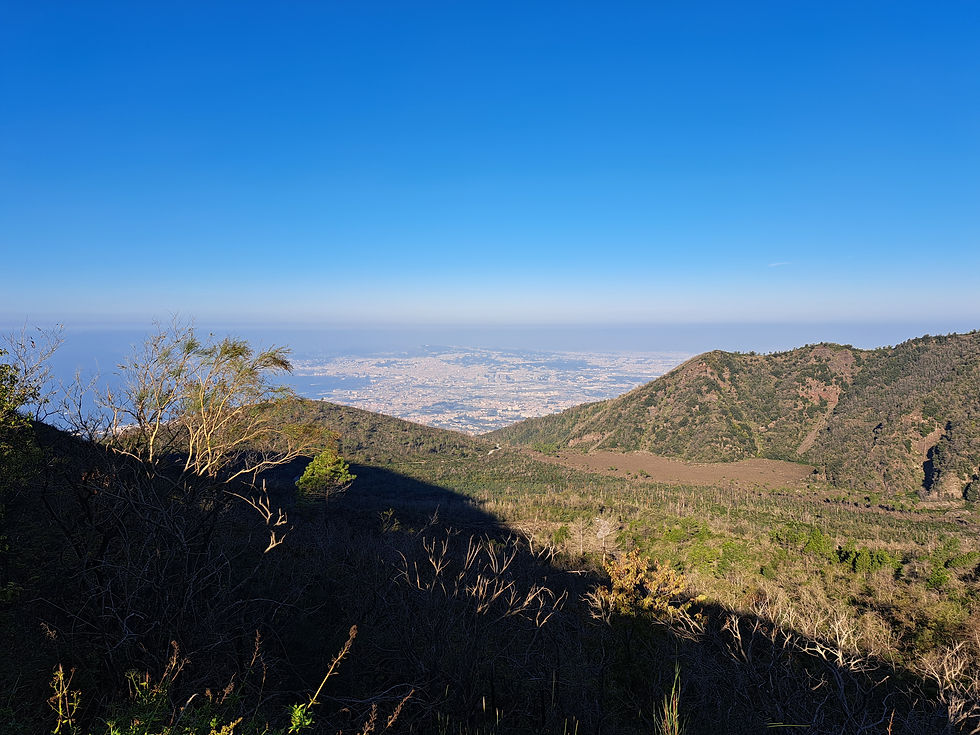
The massive crater inside the top of the mountain was impressive. Some morning dew was steaming off the rocks inside the cone during sunrise, giving an eerie vibe to the hike. Living under an active, smoldering volcano would not have been my kind of home life. Talk about stress.

After taking in the view and watching some Italian wall lizards sun bathing on the black volcanic rocks, Carson and I made our way back down to catch a bus back. The turning radius of a bus in that tiny parking lot was stretched to the max to get out, with only a couple centimeters between the front bumper and the nearest ignorant tourist. I applaud any tour bus driver heading up or down that mountain road. It was stressful enough as a passenger.

I'm grateful for the sights I've seen and the stories I get to share. Thanks again for reading and please feel free to ask any questions. Ciao!


Incredible places!!!! Yuppers lots to do and see! Thanks for sharing guys it’s such a wonderful journey!